Do not buy technology at a trade fair before you ask these seven questions
How to distinguish an impressive demonstration from a solution that will genuinely perform in production - a practitioner's perspective
On a daily basis, I assess, select, implement and integrate technology solutions for the textile and manufacturing industries. My work includes CAD/CAM systems, 3D design, PLM solutions, process automation and automated cutting technologies. The following article is based on practical experience gained from projects in which technology must work not at a trade fair stand, but in a real business environment.
Trade fairs are one of the best places to discover new technologies. In a single day, we can see solutions that would otherwise take several weeks to research, compare and test independently. We can speak with software manufacturers, see machinery in operation and find out which direction the market is taking.
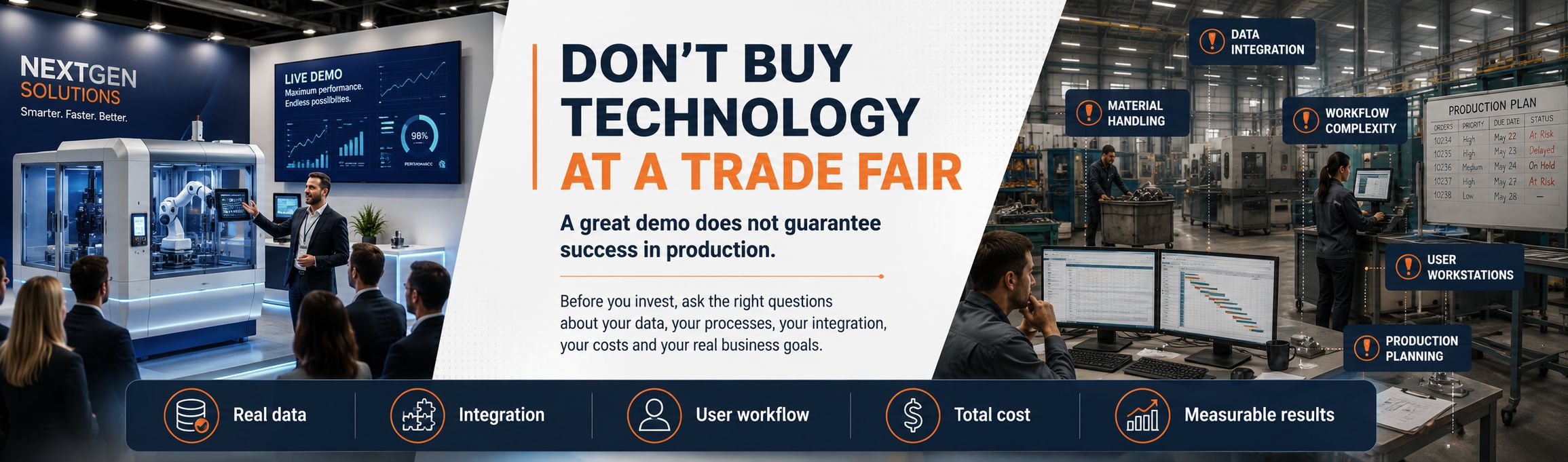
At the same time, trade fairs are an environment in which it is very easy to be swayed by first impressions. A well-prepared demonstration lasts only a few minutes. The data has been organised in advance, the material behaves perfectly, and the operator knows exactly which result they want to show. Real production, however, looks different: unusual orders arise, material properties vary, data is incomplete, there is time pressure, and the solution must work with systems that the company has been using for many years.
In my daily work, I observe that the success of an investment is rarely determined by the number of features demonstrated at a stand. Far more important are properly prepared processes, data quality, integration capabilities, user expertise and the availability of support after the system goes live.
For this reason, when I attend trade fairs, I do not assess technology solely on the basis of how impressive it looks at the stand. My primary concern is whether the solution will operate reliably in a real production environment and whether it will help achieve a clearly defined business objective.
The following seven questions are based both on market observation and on practical experience gained from working with companies implementing new software, machinery and automated processes.
1. What specific problem is this technology intended to solve?
This is the most important question, although it is very often overlooked. The discussion should not begin with the system's features. The first step is to define the problem within the company. It may be an excessively long collection development process, a large number of physical prototypes, high material consumption, documentation errors, a lack of consistent data exchange between design and production, or insufficient order visibility. Only once the problem has been identified can we assess whether the solution being presented actually eliminates it. A 3D design system may look highly attractive, but its value does not lie solely in producing realistic visualisations. What matters is whether it helps reduce the number of physical prototypes, approve designs more quickly, communicate more efficiently with the customer and transfer correct data to subsequent stages of the process.
The same applies to an automated cutting system. The fastest machine will not always be the best investment. If the bottleneck lies in data preparation, order handling, offloading cut components or material logistics, cutting speed alone may not improve the performance of the overall process.
Technology should solve a specific problem. It should not be purchased simply because it is new, impressive or widely discussed.
2. Can I see the process using my own data?
A standard demonstration presents the best possible scenario. Therefore, before making a decision, it is worth requesting a test using your own model, template, material or production file.
In the case of a CAD system, this may be an actual model containing non-standard design elements. With a 3D solution, it is worth testing your own material and a product with a known fit. During a demonstration of an automated cutting system, it is advisable to use material that is actually used in the company - particularly if it is elastic, slippery, patterned, multilayered or prone to deformation.
Such a test quickly shows how the system performs outside a carefully prepared demonstration scenario. It is also worth noting how many manual corrections the operator makes. If the final result looks very good but requires numerous hidden steps, it may be difficult to reproduce in day-to-day work.
The true value of automation begins when a solution operates reliably not only in the presenter's hands, but also in those of its future users.
3. How will the solution integrate with our current environment?
Modern textile production does not rely on a single system. Data flows between design, pattern development, 3D visualisation, costing, material planning, PLM, printing, nesting and automated cutting. Every new technology must therefore be assessed as part of a larger ecosystem.
When speaking with a supplier, I ask, among other things:
- which file formats can be imported and exported;
- whether data is transferred without any loss of information;
- whether interfaces are available to enable integration;
- how the system works with existing machinery and software;
- whether repetitive operations can be automated;
- who is responsible for the integration and its subsequent maintenance.
A statement that the system "supports a given format" is not sufficient. It is necessary to verify whether the scale, geometry, component names, layers, technical points, material information and all data required for production are preserved after import.
Incorrect integration leads to the manual re-entry of information. Instead of improving the process, this creates another point at which errors can occur.
4. What does a typical working day look like for the user?
At trade fairs, we usually see the result. In a company, the path leading to that result is more important. I therefore ask to see the entire process - from receiving an order or creating a design through to preparing the production data. I am interested in the number of stages, the time required to complete them and the points at which employee intervention is necessary.
A good system should not only offer advanced capabilities, but also make everyday tasks easier. The following should be examined:
- how many operations the user performs;
- which activities can be saved, repeated or automated;
- how the system reports errors;
- whether standard templates can be created;
- how version management is handled;
- whether several employees can work safely on the same project;
- how long it takes to prepare a new employee to work independently.
Sometimes a solution offers a very broad range of functions, but using them requires extensive specialist knowledge. This does not necessarily rule out the investment. However, the availability of the required expertise, the time needed for training and the risk of making the entire process dependent on one person must be taken into account.
In practice, users do not work with perfect data throughout the day. The system should also support them when an order is urgent, files come from different sources and the production deadline does not allow time for lengthy searches for workarounds.
5. What exactly is meant here by "automation" or "artificial intelligence"?
Terms such as "AI", "intelligent system" and "full automation" are used very broadly today. From a company's perspective, however, the name of the technology itself is not what matters. What counts is its actual impact on the time, quality and cost of the process.
I therefore ask which task is performed automatically and on what basis the system makes a decision. Does the AI generate a proposal that the user must approve? Does it analyse historical data? Does it optimise the marker layout? Does it detect inconsistencies? Does it generate a visualisation? Or does it merely speed up the search for specific functions?
It is also worth establishing:
- what data is required for the function to operate;
- whether company data is used to train external models;
- where the data is stored;
- whether the result can be verified and reproduced;
- how often manual correction is required;
- what happens if the system makes an incorrect decision.
Automation has value when it reduces repetitive operations and errors while relieving specialists of routine work. It should not create a process that the user cannot control, verify or explain.
In my work, I always distinguish the marketing label from the actual function. The most important question is: what exactly will change in the process once this solution has been implemented?
6. What are the full costs of implementation and maintenance?
The price of a licence or machine is only part of the investment cost. The calculation must also include implementation, configuration, data migration, integration, training, additional hardware, updates, servicing and the time of the employees involved in the project.
In the case of software, it is worth establishing whether the fee is a one-off payment, a subscription or dependent on the number of users. It is also necessary to determine which functions are included in the basic package and which require additional modules.
For machinery, the costs of consumables, spare parts, inspections, energy, infrastructure and any service-related downtime must be taken into account. Questions concerning the future development of the solution are particularly important:
- how long the supplier supports a given version;
- whether updates are mandatory;
- whether hardware requirements may change after an update;
- whether the company will retain access to its data after the contract ends;
- how data can be exported to another system;
- what the service response time is and who provides local support.
Good technology should be assessed on the basis of its total cost of ownership, not the price shown in a trade fair offer. Only this type of calculation makes it possible to compare fairly solutions that may appear similar at first glance.
In practice, a more expensive system may prove more cost-effective because it requires less manual work, integrates better with the existing environment and provides faster support. The opposite can also occur: an extensive solution may generate costs that the company is unable to utilise effectively.
7. How will we know whether the investment has been successful?
Measurable objectives must be defined before the purchase. These may include reducing the time required to prepare a product, decreasing the number of prototypes, improving material utilisation, reducing complaints, increasing the number of completed orders, shortening the time needed to train new employees, or improving on-time production performance.
Without previously defined indicators, it is difficult to assess whether the technology has actually delivered benefits. It is worth asking the supplier for help in preparing a realistic return-on-investment scenario, but the calculations should be based on the company's own data. Results achieved by another company may be an inspiration, but they do not guarantee a similar outcome.
In a well-prepared implementation project, the objectives are specific. Instead of making the general assumption that "we will work faster", we may specify, for example, that the time required to prepare a product variant is to be reduced from several hours to a matter of tens of minutes, or that material consumption is to fall by a defined percentage.
An objective formulated in this way can be reviewed after three, six or twelve months. It also makes it possible to identify quickly whether the problem lies in the technology itself, the configuration, the data, user training or the organisation of the process.
What should you take with you to a trade fair?
A visit to a trade fair should be prepared for in the same way as an investment meeting. Instead of collecting only catalogues and contact details, it is necessary to create the conditions for an objective comparison of solutions.
The following will be useful:
- a brief description of the current process;
- a list of the most important problems and bottlenecks;
- sample production files;
- material samples;
- information about the software and machinery currently in use;
- an approximate number of projects or orders;
- a list of required integrations;
- the same set of questions for all suppliers.
This makes it possible to compare solutions using the same criteria rather than solely on the quality of the presentation. After each meeting, it is worth recording the most important information immediately. After several hours of intensive discussions, details begin to blur, and the solution viewed last may appear to be the best simply because it is the one we remember most clearly.
A simple evaluation sheet is a useful tool. It can include compliance with requirements, ease of use, integration quality, expected costs, service availability and the result of a test using the company's own data. Such a sheet makes subsequent internal discussions within the company considerably easier.
From demonstration to decision - a specialist's perspective
Trade fairs are the beginning of the technology selection process, not its conclusion. Their greatest value lies in the opportunity to compare concepts directly, ask detailed questions and observe the directions in which the industry is developing. However, an investment decision should be made only after analysing the processes, carrying out tests and speaking with the people who will use the solution every day.
This is precisely what I do on a daily basis: I analyse existing processes, identify their weaknesses, compare available technologies and help match CAD/CAM, 3D, PLM and automation systems to the company's actual needs. The work does not end with the selection of the technology. It also includes data preparation, integration, implementation, user training and the organisation of work after the system goes live.
From practical experience, I know that even a very good solution will not deliver the expected results if it is not properly matched to the company's processes. The technology must work with the existing machinery, software, data structure and production organisation.
The involvement of future users is equally important. They understand the exceptions, workarounds and day-to-day difficulties that are often not visible at management level better than anyone else. Their knowledge helps assess whether the solution genuinely simplifies the work or merely moves the problem elsewhere.
As a specialist, I therefore assess technology not only in terms of its capabilities. I also evaluate whether it fits the organisation, the employees' skills, the available data and the company's long-term objectives.
The most advanced system is not always the best system. The best solution is one that can be implemented effectively, integrated with the existing environment and used to achieve clearly defined results.
Therefore, before purchasing technology presented at a trade fair, it is worth pausing for a moment and asking seven specific questions. The answers will reveal far more about the value of the investment than even the most impressive demonstration.
At a trade fair, you can see the future of the industry. Within the company, however, it is necessary to determine whether that future can be integrated safely, profitably and effectively into everyday work.