The 3D Body Scanner Market in 2026: Analysis of Technologies, Applications, and Development Directions
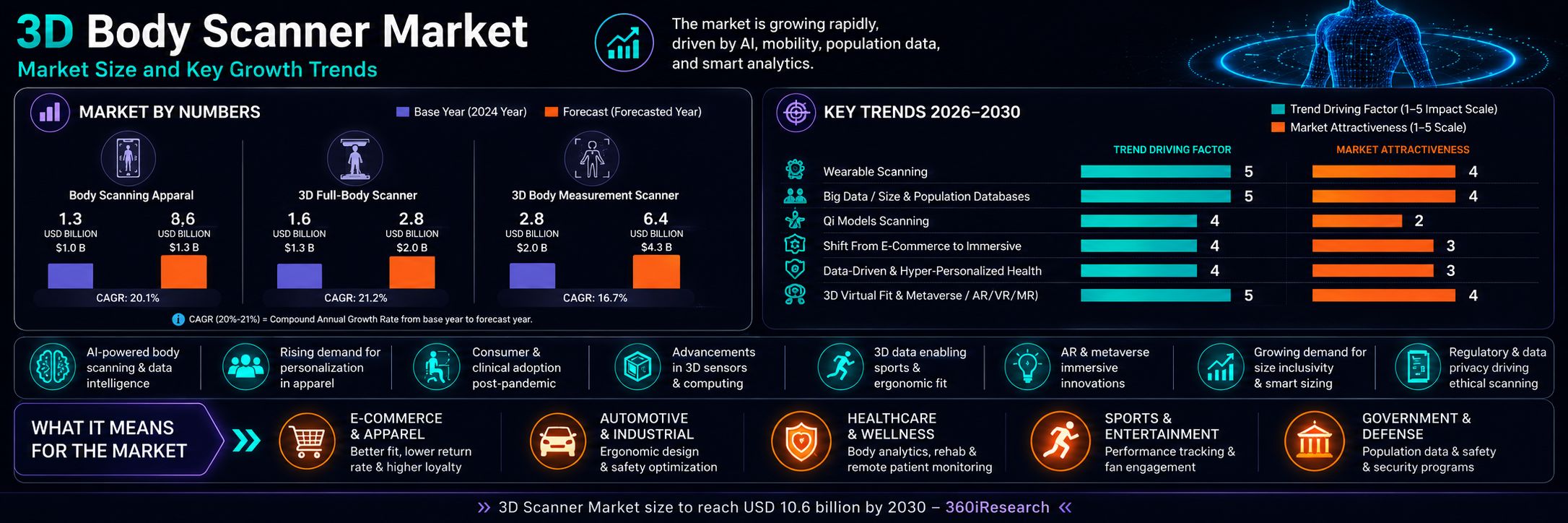
1. Introduction: the end of the “single-scanner” market
The 3D body scanner market has entered a mature stage. It can no longer be described by the simple question: “Which scanner is the most accurate?” That question is too narrow, because contemporary body scanning covers several fundamentally different classes of technologies and applications.
An anthropometric laboratory needs a different type of system than an apparel brand, a manufacturer of protective clothing, a clinic, a fitness club, or a research team analysing the body in motion. The common denominator is the digital measurement of the human body, but the objectives differ: some users require reliable anthropometric dimensions, others need size recommendation, others require an avatar model, and the most advanced teams need dynamic analysis of deformation of the body and the product during movement.
Therefore, the body scanner market should currently be analysed through four major layers:
- anthropometric and laboratory scanners,
- mobile scanners and AI-based applications,
- databases and ecosystems such as iSize,
- dynamic 4D scanners analysing the body, clothing, and objects in motion.
The most important shift is that the scanner itself is no longer the centre of the market. The centre of gravity is moving toward data: its quality, standardisation, comparability, integration with design workflows, and real decision-making value.
2. What is a 3D body scanner really?
A 3D body scanner is a system for acquiring three-dimensional information about the surface of the human body. It may generate a point cloud, a 3D mesh, a textured model, an avatar, a set of body dimensions, a body-shape change report, or input data for a design system.
From the perspective of an anthropometry expert, however, three levels must be distinguished:
Level one: a 3D image or model
The system creates a visual representation of the body. This may be sufficient for avatars, visualisation, 3D printing, or presentation of progress in fitness applications.
Level two: geometric measurement
The system determines circumferences, heights, lengths, breadths, cross-sections, surface areas, and volumes. This is useful in apparel, wellness, orthotics, and change analysis.
Level three: anthropometric measurement
The system measures the body according to defined anatomical landmarks, body postures, protocols, and standards. This is the most demanding level, because it requires not only robust geometry but also correct landmarking, posture control, validation, and compliance with dimensional definitions.
The market often confuses these three levels. A visually attractive avatar does not automatically mean reliable anthropometric measurement. An accurate point cloud does not guarantee a correct waist circumference. A mobile application may be highly effective commercially in size recommendation even though it does not replace a reference laboratory scanner.
3. Segment one: anthropometric and laboratory scanners
Anthropometric scanners are the most important category for population studies, ergonomics, technical apparel, the automotive sector, occupational medicine, health and safety, defence, sports, and product development. This group includes systems such as VITUS Bodyscan, Size Stream SS20 solutions, TC2 systems, and other full-body scanning booths used in laboratories.
Their primary value is repeatability. The subject stands in a controlled posture, usually wearing close-fitting clothing or underwear, and the system captures the scan under defined conditions. The software then identifies anatomical landmarks, cross-sections, and dimensions.
Within this segment, VITUS Bodyscan combined with Anthroscan software is particularly important. It represents a professional approach: hardware, software, measurement standards, data export, and integration with downstream systems. VITUS is intended for applications in which the value lies not in the visual effect but in data: circumferences, lengths, landmarks, 3D meshes, avatars, and reports.
Even in this class, however, the accuracy of the device must not be equated with the accuracy of every anthropometric dimension. The human body is not a rigid industrial object. It breathes, balances, changes muscle tone, and soft tissues behave differently under a manual tape measure than they do in contactless measurement. Hair, hands, axillae, crotch area, feet, clothing, shoulder positioning, and pelvic posture also introduce measurement challenges.
Therefore, an anthropometric scanner should be evaluated using the following questions:
- Does the system have validation data for the specific dimensions of interest?
- Does it operate according to a defined measurement standard?
- Does it allow landmark control and correction?
- Does it report test–retest repeatability?
- Does it allow data export?
- Does it support population-level work and statistical analysis?
- Is it compatible with the user’s design and engineering workflow?
Segment assessment
Anthropometric scanners are the best choice for organisations that require high-quality data: laboratories, manufacturers of protective clothing, automotive companies, research institutes, defence organisations, ergonomics teams, and product development departments. They are less attractive where scale, low cost, and rapid consumer access are the primary requirements.
4. Segment two: mobile scanners and AI applications
The fastest-growing part of the market is mobile scanning. This group includes applications and platforms such as 3DLOOK, NetVirta Verifyt, Size Stream Mobile, MeThreeSixty, and similar solutions that use smartphones, photographs, video, depth sensors, computer vision, and AI models.
Their advantage is clear: scale. The user does not need to visit a laboratory or a store. Measurements can be taken at home. An apparel company can collect data from thousands of customers. An e-commerce platform can recommend a size without a physical fitting room. A uniform supplier can serve a distributed workforce. A clinic or wellness programme can remotely monitor changes in body shape.
In this segment, however, quality must be assessed differently. A mobile scanner is rarely equivalent to a laboratory scanning booth. It typically does not observe the entire body from every direction under controlled conditions. Some information is estimated by a statistical model. Quality depends on the camera, lighting, pose, clothing, background, self-reported height, and algorithm quality.
This does not mean that mobile scanners are inferior. They answer a different question. An anthropometric booth asks: “What is the true body dimension according to the protocol?” A mobile application often asks: “Which size or product is most likely to fit this user?” In e-commerce, the latter answer may be more important than a laboratory dimension expressed in millimetres.
The most important applications of mobile scanners include:
- size recommendation in e-commerce,
- made-to-measure and custom fit,
- uniforms for distributed workforces,
- wellness and body-shape monitoring,
- fitness and training-progress tracking,
- footwear and foot scanning,
- orthotics and prosthetics in hybrid service models,
- rapid generation of consumer avatars.
The main risks include:
- lack of control over posture and clothing,
- incorrect input data provided by the user,
- dependence on the AI model and training population,
- reduced accuracy for atypical body shapes,
- difficulty in clinical validation,
- risk of excessive marketing claims.
Segment assessment
Mobile scanners will grow the fastest because they solve the accessibility problem. They will not fully replace laboratories, but they will capture a large share of the retail, wellness, e-commerce, and remote customer-service markets. Their business value lies not in perfect measurement of every circumference but in convenience, speed, and integration with the purchasing decision.
5. Segment three: iSize and anthropometric databases
The most underestimated element of the market is not the scanner but the database. It enables the transition from a single measurement to knowledge about a population.
Humanetics iSize is an example of this approach. The objective is not merely to collect dimensions from individual subjects, but to analyse populations: countries, regions, age groups, sex, percentiles, correlations between dimensions, and body-shape distributions. This is fundamental for designing products that fit real users.
In apparel, iSize can support the development of sizing systems. In automotive, it can support cabin ergonomics and reach envelopes. In consumer electronics, it can guide the fit of devices to hands, heads, or bodies. In sports, it can support equipment design. In protective products, it can support the fit of masks, goggles, helmets, coveralls, vests, and gloves.
This shifts the discussion from “let us measure the customer” to “let us design the sizing system and product for the actual target population.” This is critically important because many fit problems do not result from the absence of a scanner, but from poor sizing systems, outdated population data, or overly simplistic thinking about body shape.
A robust anthropometric database should enable:
- percentile analysis,
- comparison of markets and populations,
- correlations between dimensions,
- morphological segmentation,
- design of sizing systems,
- generation of representative avatars,
- selection of digital and physical fit forms,
- assessment of population accommodation by a product.
iSize is particularly important because it connects body scanning with digital ergonomics. Population data can feed systems such as RAMSIS, i.e. digital human models used in the design of vehicles, cabins, workstations, and working environments.
Segment assessment
Databases such as iSize are strategically more important than individual scanners. Companies that design globally must understand population differences. Without that understanding, even the best mobile scanner can only recommend a size within a poorly designed sizing system.
6. Segment four: 4D scanners and analysis of the body in motion
The most technologically advanced segment is 4D scanning. In this context, 4D means 3D plus time. The system does not register only the static shape of the body; it records a sequence of surface changes during motion.
Move4D is an example of a system designed for dynamic capture of shape and movement. This type of technology enables analysis of how the body deforms during walking, squatting, bending, running, raising the arms, sitting, or interacting with a product.
This is highly significant because classical anthropometry is static, while real product use is dynamic. Sportswear does not function on an immobile mannequin. Protective coveralls must work during movement. A shoe changes its relationship with the foot during the loading phase. A car seat must support the body in multiple postures. An orthosis functions during gait, not only in standing posture.
4D scanning opens new applications, including:
- sportswear analysis,
- protective clothing design,
- textile deformation studies,
- validation of apparel simulation,
- biomechanics and rehabilitation,
- gait analysis,
- footwear design,
- dynamic ergonomics,
- elite sport,
- avatars with realistic motion behaviour.
The greatest value of 4D scanners is that they reveal the interaction between the body and the product. They do not merely measure the “human body”; they measure the body–garment, body–equipment, or body–environment system.
The main limitations are equally clear: cost, data complexity, the need for specialist analysis, large file sizes, difficult standardisation, and the absence of protocols as mature as those used in classical static anthropometry.
Segment assessment
4D scanners are not mass-market retail products. They are research and industrial tools for advanced organisations. Over the long term, however, they may change the way sportswear, PPE, footwear, seats, medical devices, and body-worn products are designed.
7. Humanetics as an example of a complete ecosystem
Humanetics is one of the most interesting market players because it does not sell only a scanner. The company is building a complete ecosystem of human body data.
This ecosystem includes:
- VITUS Bodyscan as a reference system,
- Anthroscan as measurement and analytics software,
- Anthroscan Mobile 3D as a mobile solution,
- Move4D as a dynamic scanning technology,
- iSize as a population database,
- RAMSIS as a digital ergonomics environment,
- avatars and fit forms as design tools for apparel and industry.
This approach is highly mature. The market does not need only better scanners. It needs systems that transform body geometry into design decisions. This is precisely where Humanetics has a strong position.
If an apparel brand scans the body but cannot translate the data into pattern engineering, sizing systems, avatars, and fitting, the value of the scan is limited. If an automotive manufacturer has anthropometric data but does not integrate it with CAD and ergonomics, the value of the data is also limited. Humanetics attempts to solve this problem by connecting measurement, databases, and design tools.
8. Comparison of market segments
| Segment |
Primary application |
Key advantage |
Limitation |
Examples |
| Anthropometric scanners |
Research, ergonomics, technical apparel, PPE |
High repeatability and protocol control |
Cost, space, procedure |
VITUS, Size Stream SS20, TC2 |
| Mobile scanners |
E-commerce, wellness, uniforms, custom fit |
Scale, convenience, low entry threshold |
Dependence on AI, pose, lighting, and clothing |
3DLOOK, NetVirta Verifyt, Size Stream Mobile |
| Fitness/wellness |
Body-shape monitoring, progress tracking, motivation |
Change visualisation and UX |
Risk of overinterpreting body composition |
Fit3D, Styku, Bodygee |
| iSize/databases |
Sizing-system and product design |
Population knowledge and percentiles |
Requires analytical competence |
Humanetics iSize |
| Digital ergonomics |
Automotive, aviation, workstations |
Human simulation in the CAD environment |
High specialisation |
RAMSIS |
| 4D scanners |
Motion, biomechanics, dynamic apparel |
Deformation analysis over time |
Cost and data complexity |
Move4D, 3dMD 4D |
| Avatars and photogrammetry |
VR, gaming, digital fashion, 3D printing |
Visual realism and texture |
Not always reliable for anthropometry |
Botspot, Texel, 3dMD |
9. A rigorous interpretation of accuracy
Manufacturers often communicate figures such as 1 mm, 5 mm, 80 dimensions, 150 dimensions, or 240 dimensions. These data points are useful, but they must be interpreted carefully.
First, geometric accuracy is not the same as anthropometric accuracy. A system may accurately reconstruct the surface but incorrectly identify the waist or hip level if the landmarking and measurement definition are not consistent with the protocol.
Second, the number of dimensions does not automatically indicate quality. Thirty well-validated dimensions are preferable to 200 dimensions without clear information on error and repeatability.
Third, error tolerance depends on the application. In e-commerce, an error of 1–2 cm may be acceptable if it improves size recommendation. In anthropometric research, it may be unacceptable. For fitness progress tracking, repeatability may be more important than absolute agreement with manual measurement.
Fourth, the human body changes during the day. Hydration, meals, breathing, muscle tone, posture, and clothing all have an effect. Therefore, every serious scanning process should have a defined protocol.
10. Main market applications
Apparel and fashion
Body scanning is a natural tool for apparel, but its greatest value does not lie solely in measuring the customer. The real value lies in the entire process: population data, sizing system, avatar, simulation, fitting, size recommendation, production, and return-rate reduction.
For premium and made-to-measure brands, accurate dimensions are critical. For e-commerce, accurate size recommendation may be more important. For global brands, aligning the sizing system with the target population is the key issue.
PPE and protective clothing
This is one of the most underestimated segments. A helmet, mask, coverall, vest, gloves, or goggles must not only fit; it must also protect. A poorly fitted protective product may be uncomfortable, but it may also be unsafe. In this segment, anthropometric systems, databases, and dynamic motion analysis have a clear advantage.
Automotive and ergonomics
In the automotive sector, body scanning does not end with dimensions. Data flow into digital human models, simulations of reach, field of vision, ingress, egress, seated posture, and interaction with the cabin. In this context, iSize and RAMSIS form a logical chain: population data → digital human model → ergonomic validation of the design.
Fitness and wellness
In fitness, a body scanner is a motivational and communication tool. The client can see changes in body shape, circumferences, and proportions. The business value is high, but body-composition interpretation must be handled carefully. Surface scanning is not equivalent to clinical methods such as DEXA.
Medicine, rehabilitation, orthotics, and prosthetics
In medicine, documentation of changes, deformities, asymmetries, volume, and surface geometry is critical. In orthotics and prosthetics, scanning can replace or supplement traditional measurement-taking. Validation, data security, and compliance with clinical procedures are especially important.
Sport and biomechanics
4D scanners may become highly important in sport. They enable analysis of the body in motion, tissue deformation, and interaction with clothing, footwear, and equipment. This is an area in which static dimensions are insufficient.
11. Development directions of the market
The first trend is the transition from hardware to software. A growing share of value is located in algorithms, landmarking, AI models, size recommendation, and process integration.
The second trend is mobility. A smartphone will not replace the laboratory, but it will open the mass market. Wherever no measurement existed before, approximate, fast, and commercially sufficient measurement will appear.
The third trend is population databases. Companies will need not only data about an individual user, but also knowledge about populations. iSize and similar systems respond precisely to this need.
The fourth trend is dynamic anthropometry. Products are used in motion, so static data will become insufficient in the design of advanced apparel, PPE, footwear, and ergonomics.
The fifth trend is integration with digital design tools. Body scanning will be connected with CAD, PLM, CLO, Browzwear, Style3D, RAMSIS, e-commerce systems, CRM platforms, and medical applications.
The sixth trend is privacy and regulation. A 3D scan of the body is sensitive data. Companies that do not build a transparent model of consent, retention, anonymisation, and security will face legal and reputational risk.
12. Purchasing recommendations
For an anthropometric laboratory, the best choice will be a stationary reference-class system with measurement software, validation, data export, and protocol control.
For an apparel brand, the choice depends on the objective. Sizing-system development requires population data and reference scanners. E-commerce requires mobile applications and a recommendation engine. For made-to-measure, a hybrid model may be optimal.
For a PPE manufacturer, it is advisable to combine anthropometric scanning, databases, and dynamic testing. Chest circumference alone is not sufficient if the product must perform while the user raises the arms, sits down, or works in a demanding environment.
For automotive and ergonomics, iSize, RAMSIS, and digital human models are critical. The scanner is the source of data, but the competitive advantage is created in simulation and design validation.
For fitness and wellness, UX, progress reporting, and repeatability are the most important factors. Results should not be marketed as clinical diagnostics unless the system is validated for that purpose.
For motion research and sportswear, the best direction is 4D systems such as Move4D and solutions of a similar class. This is a costly segment, but it is uniquely valuable for research and advanced product development.
13. Final conclusions
In 2026, the 3D body scanner market is not primarily a market of devices. It is a market of human body data.
The most mature companies no longer ask: “Which scanner should we buy?” They ask: “Which decisions do we want to make based on body data?” This changes everything.
Anthropometric scanners will remain the foundation of research and professional databases. Mobile scanners will democratise access to measurement and dominate retail, wellness, and e-commerce. iSize and similar platforms will become critical for designing products for real populations. 4D scanners will open a new chapter: dynamic anthropometry, meaning the design of products for bodies in motion, not for immobile mannequins.
Humanetics is a strong example of the future of the market because it connects hardware, software, databases, digital ergonomics, avatars, and motion analysis. This demonstrates that the greatest value does not lie in the scan itself. The greatest value lies in translating the scan into a decision: a better size, a better product, a safer cabin, more comfortable clothing, more effective therapy, or a more realistic human model.
This is the direction in which the market will develop: from body scanning to intelligent human-centred design.
This analysis is based on my professional experience, available technical and market materials, and a critical review of current 3D body scanning technologies; however, due to the rapid pace of development in this sector, the market landscape, available solutions, and technology capabilities may evolve significantly over time. I also applied this experience in my research on textronics, where I used an anthropometric body scanner to investigate differences in human body geometry between inhalation and exhalation in order to develop a smart shirt for monitoring respiratory parameters and under-clothing microclimate temperature for uniformed services.