
Selecting a cutter, meaning an automated material cutting system, should be treated as a technological, process-related and economic decision. It is not merely the purchase of a cutting machine, but the selection of a complete cutting-room workstation that affects cut-part quality, material waste, production repeatability, unit cost, cutting-room organization and the continuity of subsequent production stages.
In industrial practice, a cutter does not operate as an isolated machine. It is part of a system that includes CAD pattern engineering, nesting, marker preparation, spreading or material positioning, stabilization on the table, vacuum hold-down, tool selection, marking, cutting, bundle preparation and quality control. For this reason, evaluating a machine only by its price, table width, cutting speed or declared number of plies is insufficient.
Apparel fashion production has different requirements from lingerie, upholstered furniture, automotive interiors, natural leather, composites, yacht production, tarpaulins, technical materials or large-format advertising. There is no single universal cutter suitable for all applications. The same machine may be highly effective in serial apparel production, yet unsuitable for natural leather, printed materials, composites or advertising substrates.
Professional cutter selection should begin with an analysis of the material, part geometry, dimensional tolerances, production series length, ply height, required throughput, marking method, cutting head configuration, available tooling and integration with CAD/CAM software.
What to Consider When Selecting a Cutting Machine, Commonly Referred to as a Cutter
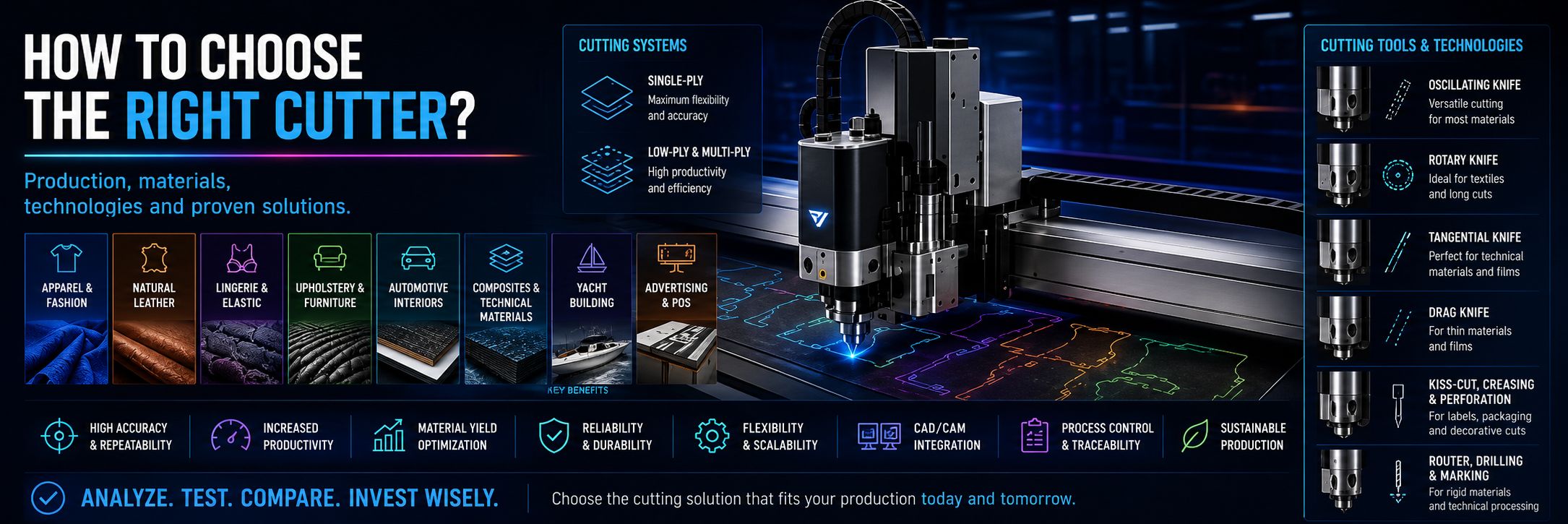
Technical Criteria for Selecting a Cutting System for Apparel, Lingerie, Upholstery, Automotive, Leather, Composites, Yacht Manufacturing, Technical Materials and Advertising Applications
1. The Cutter as a Technological System, Not Merely a Cutting Machine
A modern cutter should be understood as a technological platform. It consists of several key areas:
In serial production, repeatability and throughput are the most important factors. In technical production, accuracy, material orientation and process documentation are critical. In natural leather, material yield and defect avoidance are decisive. In advertising applications, cutting accuracy relative to the printed image is the key factor. In lingerie, precision of small elastic components is essential. In composites, fibre orientation and ply sequence are critical.
Therefore, cutter selection should always be based on the actual production process.
- working table
- vacuum system
- vacuum zones
- conveyor or static table
- cutting head
- tool modules
- CNC control
- nesting software
- CAD data import system
- camera, projector or vision system
- marking system
- cut-part collection and bundling infrastructure
In serial production, repeatability and throughput are the most important factors. In technical production, accuracy, material orientation and process documentation are critical. In natural leather, material yield and defect avoidance are decisive. In advertising applications, cutting accuracy relative to the printed image is the key factor. In lingerie, precision of small elastic components is essential. In composites, fibre orientation and ply sequence are critical.
Therefore, cutter selection should always be based on the actual production process.
2. Type of Production as the First Point of Analysis
The first stage in selecting a machine is to define what will actually be cut.
In apparel production, it is necessary to analyse the product category, series length, number of sizes, number of colours, frequency of style changes and material types. T-shirt production has different requirements from workwear, technical jackets or short-run premium apparel.
In lingerie production, the critical factors are precision of small parts, control of elastic materials, cutting lace according to the motif, and working with tulle, mesh, microfiber, powernet, foam and lingerie laminates. High-ply cutting is not always an advantage here, as it may cause ply deformation.
In furniture and upholstery production, large parts, wide tables, pile fabrics, velour, jacquards, synthetic leather, natural leather, foams, nonwovens and waddings are significant. Material waste is often a major cost factor, which makes efficient nesting software very important.
In automotive production, repeatability, traceability and process documentation are required. Frequently cut materials include multilayer structures such as fabric laminated with foam, synthetic leather with backing, Alcantara, felts, nonwovens, carpets, acoustic insulation and thermal insulation materials.
In technical, yacht and composite production, the cutter must process glass fibre, carbon fibre, aramid, prepregs, multiaxial fabrics, peel ply, films, rubber, tarpaulins, membranes, laminates, technical foams and coated materials. In these applications, a cutting error may have structural consequences, not only aesthetic ones.
In advertising and POS production, the cutter often has to function as a multifunctional processing centre. In addition to contour cutting, it should support scoring, kiss-cutting, creasing, routing, perforation and cutting according to printed registration marks.
In apparel production, it is necessary to analyse the product category, series length, number of sizes, number of colours, frequency of style changes and material types. T-shirt production has different requirements from workwear, technical jackets or short-run premium apparel.
In lingerie production, the critical factors are precision of small parts, control of elastic materials, cutting lace according to the motif, and working with tulle, mesh, microfiber, powernet, foam and lingerie laminates. High-ply cutting is not always an advantage here, as it may cause ply deformation.
In furniture and upholstery production, large parts, wide tables, pile fabrics, velour, jacquards, synthetic leather, natural leather, foams, nonwovens and waddings are significant. Material waste is often a major cost factor, which makes efficient nesting software very important.
In automotive production, repeatability, traceability and process documentation are required. Frequently cut materials include multilayer structures such as fabric laminated with foam, synthetic leather with backing, Alcantara, felts, nonwovens, carpets, acoustic insulation and thermal insulation materials.
In technical, yacht and composite production, the cutter must process glass fibre, carbon fibre, aramid, prepregs, multiaxial fabrics, peel ply, films, rubber, tarpaulins, membranes, laminates, technical foams and coated materials. In these applications, a cutting error may have structural consequences, not only aesthetic ones.
In advertising and POS production, the cutter often has to function as a multifunctional processing centre. In addition to contour cutting, it should support scoring, kiss-cutting, creasing, routing, perforation and cutting according to printed registration marks.
3. Single-Ply, Low-Ply or Multi-Ply Cutter?
One of the most important criteria is the ply capability of the machine.
Typical applications include:
It is suitable for:
Typical applications include:
Single-Ply Cutter
A single-ply cutter works on one layer of material, a single sheet, hide, print or board. It is particularly suitable where flexibility, accuracy, frequent job changes and the ability to process expensive or irregular materials are important.Typical applications include:
- sample rooms
- short-run production
- premium apparel
- lingerie
- natural leather
- digitally printed textiles
- advertising
- composites
- technical production
- personalized production
Low-Ply Cutter
A low-ply cutter can cut several or sometimes a dozen plies, depending on the material and machine construction. It is an intermediate solution between the flexibility of single-ply cutting and the productivity of multi-ply cutting.It is suitable for:
- sportswear
- technical apparel
- short fashion runs
- larger lingerie batches
- upholstery
- automotive
- technical textiles
- contract manufacturing
Multi-Ply Cutter
A multi-ply cutter is designed for high lays. It is justified when production is repetitive, series are long, materials are stable and the spreading process is well controlled.Typical applications include:
- mass apparel production
- workwear
- uniforms
- home textiles
- covers
- repetitive upholstery components
- high-volume industrial production
4. The Number of Plies Depends on the Material
The question “How many plies can the machine cut?” is too simplified. From a technological perspective, the maximum compressed lay height, ply stability, bottom-ply quality and dimensional deviations between plies are more important.
The same cutter may cut many layers of thin woven fabric, but far fewer layers of softshell, foam, laminate, elastic knit, synthetic leather or technical material. Two materials with similar fabric weight may behave completely differently during cutting.
The following aspects should be analysed:
The same cutter may cut many layers of thin woven fabric, but far fewer layers of softshell, foam, laminate, elastic knit, synthetic leather or technical material. Two materials with similar fabric weight may behave completely differently during cutting.
The following aspects should be analysed:
- lay height before compression
- lay height after compression
- friction between plies
- tendency to shift
- material resilience
- influence of vacuum hold-down
- edge quality
- accuracy of bottom plies
- stability of small parts
- behaviour of notches and holes
5. Cutting Head Tooling as a Key Selection Criterion
One of the most important criteria when selecting a cutter is the cutting head and available tooling. In practice, the head configuration determines whether the machine is suitable for a specific material.
Modern cutters may be equipped with:
The greatest mistake is assuming that one knife can cut everything. Each material requires the correct blade geometry, speed, oscillation frequency, pressure, vacuum level and cutting strategy.
Modern cutters may be equipped with:
- oscillating knife
- pneumatic oscillating knife
- electric oscillating knife
- rotary knife
- circular knife
- tangential knife
- drag knife
- kiss-cut tool
- perforation tool
- creasing tool
- V-cut tool
- router
- drill
- pen marker
- inkjet head
- labelling unit
- ultrasonic tool
- laser module
- camera
- projector
The greatest mistake is assuming that one knife can cut everything. Each material requires the correct blade geometry, speed, oscillation frequency, pressure, vacuum level and cutting strategy.
6. Oscillating Knife
The oscillating knife is one of the most universal tools used in industrial cutters. The blade performs a rapid reciprocating movement, reducing cutting resistance.
It is suitable for:
For thick materials, a stronger drive and a larger stroke are required. For thin and precision materials, thin blade geometry, material stabilization and accurate pressure control are more important.
It is suitable for:
- woven fabrics
- knitted fabrics
- nonwovens
- felts
- foams
- rubber
- synthetic leather
- upholstery materials
- technical textiles
- dry composites
- cardboard
- advertising materials
For thick materials, a stronger drive and a larger stroke are required. For thin and precision materials, thin blade geometry, material stabilization and accurate pressure control are more important.
7. Rotary Knife and Circular Knife
A rotary knife operates as a rotating circular blade. It may be advantageous for long contours, textiles, fibrous materials, meshes, technical fibres and materials prone to displacement.
Advantages of the rotary knife include:
Advantages of the rotary knife include:
- smooth cutting motion
- reduced material dragging
- good performance on long straight or curved sections
- favourable edge quality on selected textiles
8. Tangential Knife and Active Blade Control
A tangential knife has an actively controlled blade orientation relative to the cutting direction. The machine rotates the blade so that it follows the contour correctly.
This solution is important for:
This solution is important for:
- rubber
- technical materials
- films
- semi-rigid plastics
- synthetic leather
- gaskets
- cardboard
- advertising materials
9. Drag Knife
A drag knife is a simpler tool in which the blade aligns itself with the head movement through drag force. It is suitable for thin films, paper and simple contours.
However, it is not the best choice for thick, elastic, rubber-like, technical or high-precision materials. It may cause material pulling, inaccurate corners and deformation.
However, it is not the best choice for thick, elastic, rubber-like, technical or high-precision materials. It may cause material pulling, inaccurate corners and deformation.
10. Kiss-Cut, or Layer-Controlled Cutting
Kiss-cutting involves cutting the top layer of a material without cutting through the backing liner. It is very important in advertising, label production, self-adhesive films, apparel applications and technical materials with a liner.
It is used for:
It is used for:
- self-adhesive films
- labels
- stickers
- flex and flock films
- transfer materials
- gaskets with liner
- advertising materials
11. Creasing, V-Cut and Technological Scoring
In advertising, POS, packaging and foldable materials, creasing and V-cut tools are important.
Creasing creates a fold line without fully cutting through the material. It is used for cardboard, corrugated board, foam boards and POS displays.
V-cut allows an angled cut to be made so that the material can be folded cleanly. It is useful for foam boards, three-dimensional structures and advertising materials. In these applications, the cutter is no longer simply a cutting machine, but a contour processing centre.
Creasing creates a fold line without fully cutting through the material. It is used for cardboard, corrugated board, foam boards and POS displays.
V-cut allows an angled cut to be made so that the material can be folded cleanly. It is useful for foam boards, three-dimensional structures and advertising materials. In these applications, the cutter is no longer simply a cutting machine, but a contour processing centre.
12. Perforation, Drilling and Marking
In many industries, cutting the contour alone is not enough. A part may require holes, perforations, assembly notches, markings, auxiliary lines or positioning points.
Perforation is important in:
Perforation is important in:
- automotive
- upholstery
- filtration materials
- advertising
- technical textiles
- ventilation components
- pen
- inkjet
- label
- projection
- notch
- perforation
- printed code
- part number marking
13. Routing and Processing of Rigid Materials
A router is essential in advertising, POS, technical plastics, composite boards and selected structural materials. It enables the processing of materials that cannot be properly cut with a knife.
Routing is used for:
A typical apparel cutter without a suitable routing module cannot replace an industrial system for processing boards and advertising materials.
Routing is used for:
- aluminium composite panels
- acrylic
- foamed PVC
- polycarbonate
- composite boards
- foam boards
- advertising plastics
- modelling materials
A typical apparel cutter without a suitable routing module cannot replace an industrial system for processing boards and advertising materials.
14. Ultrasonic and Laser Cutting
Ultrasonic cutting can be useful for selected synthetic materials, technical textiles, tapes and materials prone to fraying. It may reduce edge fraying, but it is not a universal solution.
Laser cutting works well for selected films, synthetic textiles, advertising and technical materials, but it must be used with caution. It may cause:
Laser cutting works well for selected films, synthetic textiles, advertising and technical materials, but it must be used with caution. It may cause:
- edge melting
- discoloration
- odour
- edge hardening
- change in material hand feel
- yellowing
- emission of fumes
15. Cameras, Vision Systems and Projectors<
A camera system is essential wherever cutting must be linked to the actual position of the material, print, hide or defects.
Cameras are used for:
A projector is useful for irregular, expensive or operator-dependent materials. It projects part outlines directly onto the material, making manual positioning, defect control and grain direction assessment easier.
Cameras are used for:
- digital printing
- advertising
- panel-printed fabrics
- patterned materials
- checks and plaids
- lace
- natural leather
- defective materials
- composites requiring orientation control
A projector is useful for irregular, expensive or operator-dependent materials. It projects part outlines directly onto the material, making manual positioning, defect control and grain direction assessment easier.
16. Cutters for Natural Leather
Cutters for natural leather are a separate technological category. Natural leather should not be treated as roll material or as multilayer fabric. Each hide has an individual shape, variable thickness, quality zones, stretch behaviour, scars, holes, discoloration and natural structural differences.
For this reason, natural leather is most often cut in a single-ply system. A typical process includes:
For this reason, natural leather is most often cut in a single-ply system. A typical process includes:
- placing the hide on the table
- digitizing the hide outline
- marking defects
- classifying quality zones
- assigning parts to zones
- automatic or semi-automatic nesting
- projecting the layout
- operator approval
- cutting
- marking
- part collection and bundling
- accuracy of hide outline recognition
- quality of defect mapping
- ability to define quality zones
- nesting speed
- possibility of manual layout correction
- cutting precision
- no damage to the grain side
- stable vacuum hold-down
- possibility of marking on the flesh side
- material yield reporting
- integration with the production system
17. Natural Leather vs Synthetic Leather
Natural leather and synthetic leather require completely different approaches.
Natural leather:
- has an irregular shape
- occurs as individual hides
- has quality zones
- has natural defects
- requires defect mapping
- is usually cut single-ply
- requires highly efficient nesting
Synthetic leather:
- is usually supplied in rolls
- has a repeatable width
- can be cut from a marker
- can sometimes be cut in low plies
- requires control of backing and coating
- may have direction, gloss or texture
- may deform under vacuum hold-down
18. Apparel Production
In conventional apparel production, a cutter must process woven fabrics, knitted fabrics, linings, interlinings, insulation materials, softshells, fleece, coated fabrics, lace and elastane materials.
In mass apparel production, productivity and repeatability are essential. In womenswear, premium and short-run production, flexibility and part accuracy are more important. In sportswear, elastic knits, laminates, softshells and technical materials are critical.
The most important criteria are:
In mass apparel production, productivity and repeatability are essential. In womenswear, premium and short-run production, flexibility and part accuracy are more important. In sportswear, elastic knits, laminates, softshells and technical materials are critical.
The most important criteria are:
- lay stability
- dimensional consistency between top and bottom plies
- quality of assembly notches
- control of material direction
- handling of elastane materials
- relaxation of knitted fabrics
- CAD/CAM integration
- automatic part marking
19. Lingerie and Elastic Apparel
Lingerie requires very high precision. Parts are small, often asymmetric and made from materials prone to stretch. Lace, tulle, mesh, powernet, microfiber, foam and lingerie laminates require careful tool selection.
In lingerie, the following factors are particularly important:
In lingerie, the following factors are particularly important:
- minimal material deformation
- precision of small radii
- lace cutting according to motif
- control of elasticity
- low tool pressure
- properly adjusted vacuum
- possibility of single-ply or low-ply operation
- camera system for lace and printed materials
20. Upholstered Furniture
In upholstered furniture, the main challenges are large components, pile fabrics, leather, velour, jacquards, foams, waddings and high waste cost.
A cutter for upholstery should have:
A cutter for upholstery should have:
- a wide table
- strong vacuum hold-down
- the ability to cut large parts
- support for directional pile fabrics
- tools for thick textiles
- foam-cutting capability
- projector or camera
- efficient nesting software
21. Automotive
Automotive production requires repeatability, traceability and process documentation. Materials are often multilayer structures: fabric with foam, synthetic leather with backing, Alcantara, felt, nonwoven, carpet, acoustic insulation or thermal material.
A cutter for automotive should support:
A cutter for automotive should support:
- high dimensional repeatability
- part marking
- production reporting
- laminated material processing
- foam and nonwoven cutting
- perforation
- batch control
- integration with the quality system
22. Composites, Yacht Manufacturing and Technical Production
The most important factor is fibre orientation control. A composite part is not merely a geometric shape. Fibre direction affects the mechanical properties of the finished laminate.
The system should support:
The system should support:
- blocking part rotation
- ply description
- ply numbering
- lay-up sequence
- part marking
- fibre direction control
- cutting without fibre pull-out
- clean edge quality
- minimal material contamination
23. Advertising and POS
In advertising, the cutter often has to be a multifunctional machine. It should cut, score, crease, route, perforate and cut according to the printed contour.
Typical materials include:
Typical materials include:
- self-adhesive films
- vinyls
- banners
- printed textiles
- paper
- cardboard
- corrugated board
- foam boards
- PVC
- acrylic
- aluminium composite panels
- PET
- polycarbonate
- magnetic materials
24. Technological Testing Before Purchase
Before purchasing a cutter, testing on the company’s own materials and real production markers is essential. A test performed on the supplier’s demonstration material does not provide a complete technological answer.
The following should be checked:
The following should be checked:
- edge quality
- dimensional accuracy
- differences between plies
- corner quality
- quality of small parts
- vacuum stability
- tool marks
- fraying
- melting
- deformation
- material shifting
- notch accuracy
- perforation quality
- marking effectiveness
- preparation time
- cutting time
- bundling time
- blade wear
- waste level
25. Most Common Mistakes When Selecting a Cutter
The most common mistakes include:
- selecting a machine based only on price
- selecting a machine based only on speed
- no material analysis
- no testing on real materials
- purchasing a multi-ply cutter for short-run production
- purchasing a single-ply cutter for mass production without throughput analysis
- underestimating the importance of cutting heads and tools
- no camera system for print or leather
- no projector for irregular materials
- no router for advertising applications
- no tools for perforation and marking
- failure to consider the cost of blades and spare parts
- lack of local service support
- poor CAD/CAM integration
- no procedures for material preparation
Summary
Selecting a cutter should be treated as a technological decision that affects the entire production preparation process, not merely as the purchase of another machine for the cutting room. In industrial practice, an automated cutting system determines part accuracy, dimensional stability, waste level, labour efficiency, production repeatability, downstream assembly quality and the real unit cost of the product. Therefore, before selecting a specific solution, it is necessary to analyse not only the catalogue parameters of the machine, but above all the actual production profile, processed material groups, series length, required tolerance, cutting-room organization and integration capabilities with CAD/CAM systems.
There is no single universal cutter suitable for every industry. Mass apparel production, lingerie, upholstered furniture, automotive interiors, natural leather, composites, yacht manufacturing, technical materials and large-format advertising all require different parameters. In serial apparel production, the key factors may be multi-ply cutting efficiency, lay stability and fast bundle preparation. In lingerie, greater importance is placed on the precision of small parts, limiting deformation of elastic materials and the ability to process lace, mesh and elastane knits. In upholstery, decisive factors include table width, handling of large components, pile direction control, foam cutting and optimization of expensive material usage. In automotive, repeatability, process reporting, batch traceability, part marking and compliance with industrial customer quality requirements are the most important.
Systems intended for natural leather require special analysis. Leather is not a roll material with constant width and repeatable structure. Each hide has an individual outline, variable thickness, natural defects, quality zones, differences in elasticity and non-uniform surface properties. Therefore, a leather cutter should be evaluated primarily in terms of hide digitization, defect mapping, quality zone definition, automatic or semi-automatic nesting and material yield. In this case, cutting speed itself is less important than correct part placement and reduction of raw material loss. A few percentage points of improvement in leather utilization may have a greater economic impact than a difference in cutting time.
In composite, yacht and technical component production, the key issue is not only cutting the contour, but also controlling fibre orientation, ply numbering, lay-up sequence, part marking and process cleanliness. Materials such as glass fibre, carbon fibre, aramid, prepregs, multiaxial fabrics, technical films, rubber, tarpaulins and laminates require a different approach from conventional apparel textiles. An error in fibre direction or ply sequence may affect the structural parameters of the finished component, not only its appearance. In such applications, the cutter should be part of a controlled technological process linked to technical documentation, marking systems and quality control procedures.
Ply capability is another very important selection criterion. A single-ply cutter is suitable where production is variable, series are short, the material is expensive, irregular, printed, elastic or requires individual positioning. A low-ply cutter is a good compromise for companies that need higher productivity but do not constantly work with high lays. A multi-ply cutter is justified mainly in serial, repetitive and well-planned production based on stable materials that can be safely spread in multiple plies. However, the number of plies should never be analysed independently from the material. Compressed lay height, ply stability, inter-ply friction, material resilience, edge quality and bottom-ply accuracy are far more important.
One of the most important elements of a modern cutter is the cutting head and available tooling. In practice, the head configuration determines whether the machine is suitable for a given application. Oscillating knife, rotary knife, tangential knife, drag knife, kiss-cut tool, perforation head, creasing tool, V-cut tool, router, pen marker, inkjet, drill, projector, camera or marking module are not marketing accessories, but real process tools. Their correct selection allows the machine to perform not only contour cutting in one cycle, but also assembly notches, perforations, fold lines, technological markings, holes, part numbering or cutting relative to print.
In the advertising and POS sector, the cutter should be treated more as a multifunctional processing centre than a conventional cutting machine. It must process self-adhesive films, vinyls, banners, printed textiles, cardboard, corrugated board, foam boards, PVC, acrylic, aluminium composite panels, PET, polycarbonate and magnetic materials. For this reason, camera systems for registration mark recognition, print distortion compensation and cutting according to the actual graphic contour are essential. In this sector, kiss-cutting, creasing, routing, dust extraction, material fixation and fast tool changes are also highly significant.
Before purchasing a machine, testing on the company’s own materials, own markers and real production parts is essential. A test performed on the supplier’s demonstration material does not provide a complete technological answer. Edge quality, dimensional accuracy, stability of small parts, corner quality, material behaviour under vacuum, marking effectiveness, blade wear, job preparation time, cutting time, bundling time and waste level should all be assessed. The test should include the most difficult materials, not only the easiest ones to cut.
Ultimately, the best cutter is not the one with the highest declared speed or the largest number of plies in the catalogue. The best cutter is the one that provides a stable, repeatable and cost-effective cutting process in a specific production environment. In a well-designed cutting room, the cutter connects CAD/CAM data, material properties, nesting strategy, tool selection, quality control and cut-part logistics. Its value should be measured not only by cutting speed, but above all by cut-part quality, material yield, error reduction, service availability, configuration flexibility and the ability to grow with production.
The purchasing decision should therefore result from a precise technological analysis: what will be cut, in what quantities, with what accuracy, with which tool, in how many plies, with what marking method and at what waste cost. Only this approach makes it possible to select a machine that not only accelerates cutting, but genuinely improves the quality, organization and profitability of the entire production process.
There is no single universal cutter suitable for every industry. Mass apparel production, lingerie, upholstered furniture, automotive interiors, natural leather, composites, yacht manufacturing, technical materials and large-format advertising all require different parameters. In serial apparel production, the key factors may be multi-ply cutting efficiency, lay stability and fast bundle preparation. In lingerie, greater importance is placed on the precision of small parts, limiting deformation of elastic materials and the ability to process lace, mesh and elastane knits. In upholstery, decisive factors include table width, handling of large components, pile direction control, foam cutting and optimization of expensive material usage. In automotive, repeatability, process reporting, batch traceability, part marking and compliance with industrial customer quality requirements are the most important.
Systems intended for natural leather require special analysis. Leather is not a roll material with constant width and repeatable structure. Each hide has an individual outline, variable thickness, natural defects, quality zones, differences in elasticity and non-uniform surface properties. Therefore, a leather cutter should be evaluated primarily in terms of hide digitization, defect mapping, quality zone definition, automatic or semi-automatic nesting and material yield. In this case, cutting speed itself is less important than correct part placement and reduction of raw material loss. A few percentage points of improvement in leather utilization may have a greater economic impact than a difference in cutting time.
In composite, yacht and technical component production, the key issue is not only cutting the contour, but also controlling fibre orientation, ply numbering, lay-up sequence, part marking and process cleanliness. Materials such as glass fibre, carbon fibre, aramid, prepregs, multiaxial fabrics, technical films, rubber, tarpaulins and laminates require a different approach from conventional apparel textiles. An error in fibre direction or ply sequence may affect the structural parameters of the finished component, not only its appearance. In such applications, the cutter should be part of a controlled technological process linked to technical documentation, marking systems and quality control procedures.
Ply capability is another very important selection criterion. A single-ply cutter is suitable where production is variable, series are short, the material is expensive, irregular, printed, elastic or requires individual positioning. A low-ply cutter is a good compromise for companies that need higher productivity but do not constantly work with high lays. A multi-ply cutter is justified mainly in serial, repetitive and well-planned production based on stable materials that can be safely spread in multiple plies. However, the number of plies should never be analysed independently from the material. Compressed lay height, ply stability, inter-ply friction, material resilience, edge quality and bottom-ply accuracy are far more important.
One of the most important elements of a modern cutter is the cutting head and available tooling. In practice, the head configuration determines whether the machine is suitable for a given application. Oscillating knife, rotary knife, tangential knife, drag knife, kiss-cut tool, perforation head, creasing tool, V-cut tool, router, pen marker, inkjet, drill, projector, camera or marking module are not marketing accessories, but real process tools. Their correct selection allows the machine to perform not only contour cutting in one cycle, but also assembly notches, perforations, fold lines, technological markings, holes, part numbering or cutting relative to print.
In the advertising and POS sector, the cutter should be treated more as a multifunctional processing centre than a conventional cutting machine. It must process self-adhesive films, vinyls, banners, printed textiles, cardboard, corrugated board, foam boards, PVC, acrylic, aluminium composite panels, PET, polycarbonate and magnetic materials. For this reason, camera systems for registration mark recognition, print distortion compensation and cutting according to the actual graphic contour are essential. In this sector, kiss-cutting, creasing, routing, dust extraction, material fixation and fast tool changes are also highly significant.
Before purchasing a machine, testing on the company’s own materials, own markers and real production parts is essential. A test performed on the supplier’s demonstration material does not provide a complete technological answer. Edge quality, dimensional accuracy, stability of small parts, corner quality, material behaviour under vacuum, marking effectiveness, blade wear, job preparation time, cutting time, bundling time and waste level should all be assessed. The test should include the most difficult materials, not only the easiest ones to cut.
Ultimately, the best cutter is not the one with the highest declared speed or the largest number of plies in the catalogue. The best cutter is the one that provides a stable, repeatable and cost-effective cutting process in a specific production environment. In a well-designed cutting room, the cutter connects CAD/CAM data, material properties, nesting strategy, tool selection, quality control and cut-part logistics. Its value should be measured not only by cutting speed, but above all by cut-part quality, material yield, error reduction, service availability, configuration flexibility and the ability to grow with production.
The purchasing decision should therefore result from a precise technological analysis: what will be cut, in what quantities, with what accuracy, with which tool, in how many plies, with what marking method and at what waste cost. Only this approach makes it possible to select a machine that not only accelerates cutting, but genuinely improves the quality, organization and profitability of the entire production process.