
Pitfalls in MTM Pattern Construction
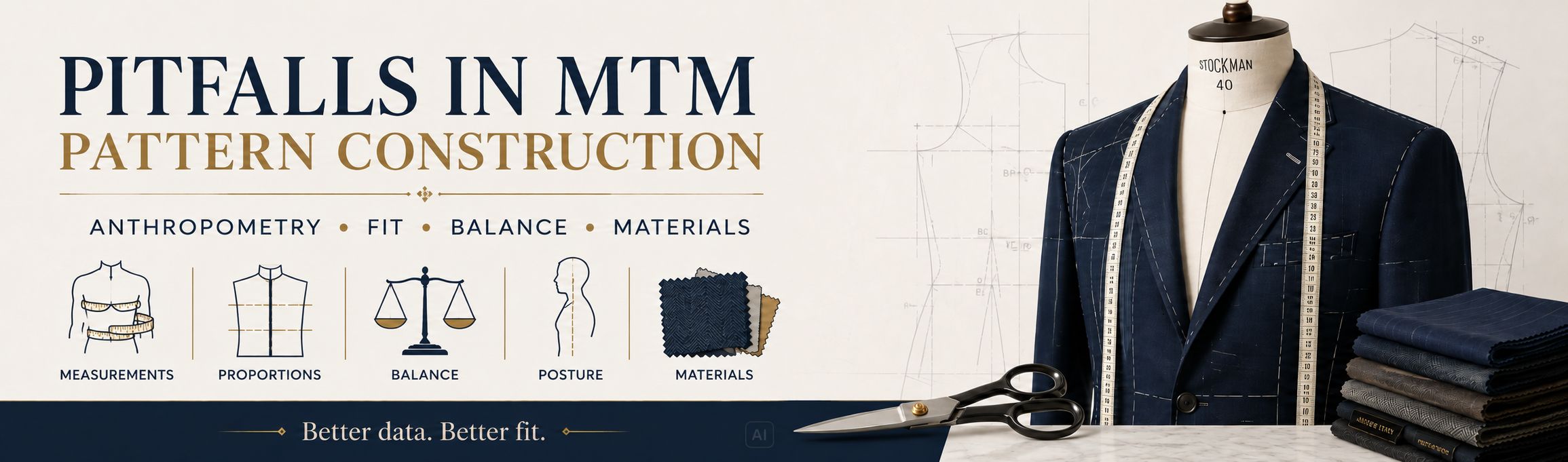
Anthropometry, Garment Pattern Construction and the Responsibility of the Patternmaker
The MTM system, meaning Made to Measure, is very often presented as a modern response to the need for individual garment fit. From the customer’s perspective, it sounds simple: we take body measurements, the system selects the appropriate base size, the construction is corrected, and the final garment is expected to fit better than a ready-to-wear product. In patternmaking practice, however, it is one of the more demanding processes, because it requires the combination of human anthropometry, pattern geometry, material technology and experience in assessing the human figure.
The greatest misunderstanding around MTM is the belief that precise measurement automatically gives precise fit. Measurement is only input information. It is not yet a construction. The human body is not a simple solid that can be described by several circumferences and lengths. It is a spatial, asymmetrical, mobile and posturally variable system. Garment construction must interpret this system, simplify it and translate it into flat pattern pieces which, after sewing, will create a functional, aesthetic and repeatable garment form.
Therefore, professional MTM cannot be treated as an extended size chart. It is a separate methodology of the patternmaker’s work.
1. The Body Measurement Is Not the Garment Measurement
The basic principle of MTM construction is to separate three concepts: the body measurement, the pattern measurement and the finished garment measurement. They are connected with one another, but they are not the same.
The customer’s chest circumference is not the circumference of the jacket. The waist circumference is not the circumference of the trousers. The arm length is not simply the sleeve length. Each measurement requires interpretation through construction ease, the function of the garment, material properties, sewing technology and the expected visual effect.
The same body circumference is interpreted differently in a shirt, differently in a jacket, differently in a coat and differently again in technical clothing. Each product has a different function, different layering, different range of movement and different level of fit. For this reason, the direct transfer of anthropometric values onto the pattern is one of the most common sources of errors.
Good MTM systems do not analyse only: "how many centimetres does the customer have?". Good MTM systems analyse: "what does this measurement mean from a construction point of view?".
2. The Figure Is a System of Proportions, Not a Sum of Circumferences
In the traditional approach to measurement, the greatest importance is often attached to the circumference of the chest, waist, hips, thigh or arm. These are, of course, important data, but they are insufficient. Two people with the same chest circumference may require a completely different construction.
One figure may have a broad front and a narrow back. Another may have developed back muscles and a flat chest. A third may have a protruding abdomen, retracted shoulders and a shortened functional front. If the MTM system distributes the correction evenly around the entire circumference, it enlarges the garment, but does not necessarily improve how it sits on the body.
In construction, the distribution of volume matters. It is crucial to determine where the body actually needs space: at the front, at the back, at the sides, in the upper back area, around the abdomen, buttocks or thigh. The circumference alone does not answer this question.
This is exactly why an experienced patternmaker analyses proportions, not only numbers.
3. The Construction Base Must Be Prepared for Corrections
One of the greatest pitfalls when implementing MTM is using a standard production pattern as the base for personalisation. A production pattern is usually developed for a specific size group and an averaged figure. Its purpose is to serve repeatable production, not a wide range of individual corrections.
The MTM base should be constructed differently. It must have clearly defined control points, balance lines, areas of permissible changes and dependencies between elements. The patternmaker should be interested not only in whether the pattern can be widened, but also in what will happen to the armhole, sleeve, side seam, dart, front and back balance and the arrangement of the entire garment.
A correction made in one area almost always affects other areas. Widening the chest may change the armhole curve. Changing the front length may disturb the side seam line. A shoulder correction affects sleeve setting. Increasing the volume at the hips in trousers may require a change to the crotch curve.
MTM requires a construction that is prepared for change, not a construction that is forced to change.
4. Fit Is More Important Than Additional Ease
Many fit problems are not solved by adding centimetres. Very often, the cause is not a lack of volume, but an incorrect fit of the garment.
Fit determines how the garment sits on the figure in relation to the front, back, side, shoulders and centre of gravity. If the balance is incorrect, the garment may shift, pull, stand away, twist or create folds despite theoretically correct measurements.
Typical symptoms of disturbed fit include a collar standing away from the neck, a jacket back lifting up, a front opening, a shifted side seam, a twisted sleeve, tension under the armhole or trousers dropping at the back. In such cases, simply widening the garment may only apparently improve comfort, while reducing the aesthetics and precision of the fit.
Professional MTM must have separate rules for stooped figures, over-erect figures, figures with rounded backs, a protruding abdomen, shoulder asymmetry or an unusual pelvic position. Without balance analysis, MTM becomes only a mechanical correction of measurements.
5. Body Posture Changes the Geometry of the Pattern
Anthropometry used in clothing should not be limited to linear and circumferential measurements. Assessment of body posture is equally important. The position of the head, shoulders, spine, pelvis and limbs affects the way the garment sits on the figure.
A stooped figure requires a different relationship between front and back length than an erect figure. A rounded back changes the volume requirement in the upper back area. Prominent shoulder blades affect the width and length of the back. A protruding abdomen affects not only the waist circumference, but also the front length, the position of the fastening and the side balance.
In trousers, pelvic posture affects the rise height, crotch length, waistband position and the behaviour of the trouser leg. Two people with identical hip circumference may need a completely different back trouser construction.
MTM that does not classify posture is not a complete fit system. It is only a system of measurement modification.
6. Sleeve and Armhole Are the Test of Construction Quality
The area of the shoulder, armhole and sleeve is one of the most demanding in the entire garment construction process. This is where the limitations of a poorly designed MTM system most often become visible.
Sleeve comfort does not result only from its width. It depends on the shoulder slope, limb rotation, armhole depth, sleeve cap height, back width, shoulder position and the range of movement intended for the given garment.
A common mistake is lowering the armhole in order to achieve greater comfort. In practice, an armhole that is too deep may restrict movement, because when the arm is raised, it pulls the entire garment upwards. The wearer receives more static ease, but less dynamic freedom.
A well-constructed sleeve should look correct in the neutral position and at the same time allow natural movement. In MTM this is particularly important, because the customer does not evaluate the product only in front of the mirror. They evaluate it while walking, working, sitting, driving a car and performing everyday gestures.
7. MTM Trousers Require More Than Waist Measurement
In trouser construction, one of the greatest oversimplifications is reducing fit to the waist and hip circumferences. Meanwhile, trouser quality depends on pelvic geometry, the shape of the buttocks, crotch curve length, and the position of the thigh, knee and calf.
Trousers may be correct in terms of measurements and at the same time uncomfortable. They may look good in a standing position, but create tension when sitting. They may have the correct thigh circumference, but twist around the leg because of incorrect leg positioning.
- rise height
- front and back crotch curve length
- buttock volume
- the course of the inseam
- knee line positioning
- thigh and calf circumference
- trouser behaviour in a sitting position
Good MTM trousers are not only fitted to a measurement. They are fitted to the way the body works.
8. Asymmetry Is Natural and Requires a Patternmaker’s Decision
In measurement practice, a perfectly symmetrical figure is rarely encountered. Differences in shoulder height, limb length, hip position or limb circumferences are normal phenomena. The problem is not asymmetry itself, but the way it is interpreted.
Not every asymmetry should be reproduced literally in the construction. Sometimes it must be corrected functionally, sometimes visually neutralised, and sometimes accepted within the aesthetic limits of the garment. Excessive reproduction of asymmetry may make the garment technically close to the body, but visually give the impression of being crooked.
This is particularly important in jackets, coats, shirts and formal trousers, where vertical and horizontal lines, lapels, pockets, cuffs and seams are easily assessed by the eye. MTM therefore requires not only the measurement of asymmetry, but also a decision on how to transfer that asymmetry into the pattern without losing aesthetics.
9. The Material Can Help or Destroy the Fit
There is no MTM construction detached from the material. The same pattern made from a stable woven fabric, knitted fabric, wool with elastane, softshell or laminate will behave differently.
The material affects construction ease, dimensional stability, seam performance, drape over body curves, reaction to pressing, susceptibility to deformation and movement comfort. Stretch materials are particularly demanding, because they often mask construction errors at the fitting stage, but reveal them later during use, washing or prolonged wear.
Elasticity does not release the patternmaker from precision. On the contrary - it requires even greater control. Incorrect ease in a stretch material may cause tension, seam waviness, edge stretching, twisting of elements and loss of the original shape.
Therefore, a professional MTM system should have separate rules for material groups. A correction developed for a stable woven fabric cannot be automatically transferred to a knitted fabric or a material with high stretch.
10. Measurement Technology Does Not Replace the Patternmaker’s Knowledge
3D scanners, automatic measurement systems and digital configurators are valuable tools. They allow a large amount of data to be collected and enable the analysis of body cross-sections, proportions and posture. This does not mean, however, that they create a good construction on their own.
The scanner measures the body. It does not yet understand the character of the model, the brand style, material behaviour, sewing technology or fit aesthetics. It does not decide where to add volume, how to correct balance, how to set the sleeve and when exceeding the MTM range should be classified as an individual construction.
The best results are achieved by combining technology with the experience of the patternmaker. Measurement data should be filtered through construction rules, fitting tests, complaint analysis and control of finished garments. Without this, a digital system may produce patterns that are mathematically precise, but functionally incorrect.
11. MTM Must Have Technological Boundaries
From the marketing point of view, it is easy to promise the customer full personalisation. From the production point of view, however, every personalisation must have boundaries. If the customer can change everything - proportions, the scope of fit, details, material and construction - the process stops being MTM and begins to resemble full bespoke tailoring.
- which corrections are standard
- which require the patternmaker’s assessment
- which exceed the capabilities of the base
- which materials are approved for the given model
- when the order should be reclassified as an individual service
Such boundaries do not limit quality. On the contrary - they protect quality. They help avoid a situation in which the product is sold as repeatable MTM, but produced like one-off bespoke, without the correct pricing, time and risk control.
12. Documentation Is a Condition of Repeatability
MTM should not rely only on the patternmaker’s memory. Every decision concerning the figure, base, correction, material and tolerance should be documented. Only then can the process be developed, analysed and scaled.
- input measurements
- figure classification
- selected construction base
- applied corrections
- justification of corrections
- type of material
- pattern version
- control tolerances
- result of finished garment inspection
- information about alterations or complaints
Such documentation has enormous value. It makes it possible to check which corrections work, which bases are too limited, which materials cause problems and which figure types require separate construction solutions.
Without documentation, MTM is a service dependent on a single specialist. With documentation, it becomes a system.
13. The Marketing Promise Must Be Consistent with the Capabilities of the Construction
A customer buying MTM expects a product that fits better than standard ready-to-wear sizing. This is understandable. The problem appears when marketing communication promises "perfect fit", while the technology offers only a limited correction of lengths and circumferences.
A professional brand should communicate MTM as a process, not as a magical guarantee of perfection. It is worth emphasising figure analysis, selection of the construction base, proportion correction, adaptation to the material, quality control and the possibility of improving subsequent orders.
Such communication is more honest and more credible. It shows the customer that behind the product there is knowledge, experience and a controlled process, not only a measurement application or configurator.
Summary
MTM construction is a demanding area in which knowing body measurements is not enough. Their meaning must be understood. Circumference does not describe the distribution of volume. Length does not describe posture. A 3D scan does not replace the patternmaker’s decision. Stretch material does not repair an incorrect pattern. Additional ease does not solve the problem of disturbed balance.
Professional MTM requires a stable construction base, anthropometric knowledge, figure classification, conscious interpretation of data, material control and precise documentation. Only the combination of these elements makes it possible to create a garment that is not only consistent with the measurement, but above all sits well on the body and meets the user’s expectations.
From the perspective of a garment patternmaker, MTM is not an addition to standard production. It is a separate working system. It requires responsibility, testing and experience. A brand that is able to implement it consciously gains an advantage: better fit, fewer complaints, greater repeatability and higher product value in the eyes of the customer.