Material Selection and Sewing Technology: An Expert Perspective on Fabric Performance
In professional apparel manufacturing, material selection must be treated as a technical decision, not only as a visual or commercial choice. A fabric is not a passive surface used to realize a design concept. It is a structured textile system with specific mechanical, dimensional and processing characteristics. These characteristics determine how the material behaves during cutting, sewing, pressing, fusing, finishing and later during use. For this reason, the selection of fabric should always be evaluated together with the intended sewing technology. A technically correct product is not created by choosing a fabric first and solving production problems later. It is created by matching the fabric structure, garment construction, seam engineering, machine settings and finishing parameters from the beginning of the development process.
Fabric Mechanics as a Critical Production Factor
Fabric mechanics is one of the most important, and often underestimated, areas in garment development. It describes how a textile material reacts to tensile forces, bending, shear, compression, friction, repeated deformation and local stress concentration.
In woven fabrics, the mechanical response is strongly directional. The warp, weft and bias directions do not behave in the same way. This anisotropy affects dimensional stability, drape, seam performance and the way the garment adapts to body movement. In knitted fabrics, loop structure, stretch recovery and deformation under load become equally critical. From a production point of view, the most important mechanical properties include tensile strength, tear resistance, abrasion resistance, bending stiffness, shear behavior, elastic recovery and seam slippage tendency. These parameters directly influence the durability of the garment, the appearance of the seams and the stability of the finished shape. A material with poor mechanical compatibility may look acceptable on a roll but fail during sewing or after the first washing cycle. Typical consequences include seam puckering, open seams, edge distortion, bagging at stress points, permanent deformation, needle damage or loss of fit.
The Fabric–Seam Interaction
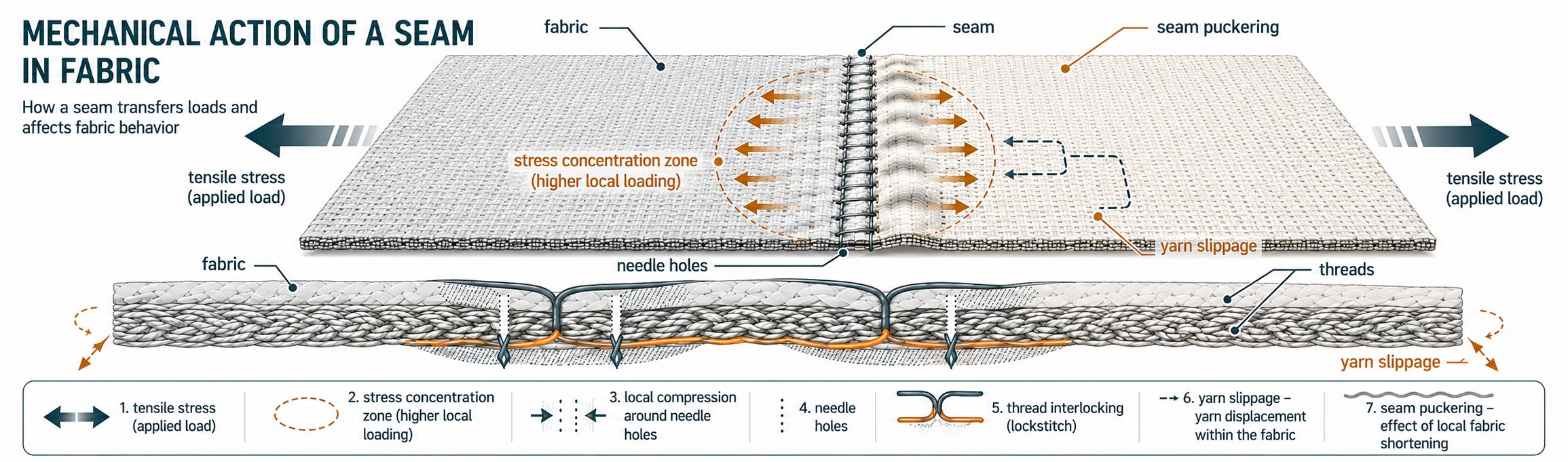
A seam is not simply a line of stitching. It is a mechanically stressed area where the fabric is perforated, compressed and joined by thread. This makes the seam zone one of the most critical areas of the product. In tightly woven fabrics, needle penetration can damage yarns and leave visible holes. In loosely woven fabrics, yarns may shift under load, causing seam slippage. In elastic fabrics, a rigid stitch can restrict stretch and lead to thread breakage. In heavy multilayer constructions, the main risks are poor feeding, skipped stitches, uneven stitch formation and excessive needle heating. Therefore, seam type, stitch density, thread size, needle system, presser foot pressure and feeding method must be selected according to the actual behavior of the fabric. A standard sewing parameter cannot be applied safely to every material category.
Material Parameters That Must Be Verified
A professional material assessment should include more than composition and fabric weight. The following parameters are essential before approving a fabric for production:
| Parameter | Verification |
|---|---|
| Fabric structure | The weave, knit structure, coating, lamination or surface finish determines stability, fraying tendency, stretch behavior, thickness and susceptibility to damage. |
| Weight, thickness and compressibility | Fabric weight alone is not sufficient. Two fabrics with the same gram weight may behave differently under the presser foot due to differences in thickness, density and compressibility. |
| Dimensional stability | Shrinkage after washing, steaming, pressing or relaxation must be checked in both main directions. This is especially important when the shell fabric, lining, interlining, tapes and thread have different dimensional behavior. |
| Stretch and recovery | For fabrics with elastane or mechanical stretch, recovery is just as important as elongation. Poor recovery leads to bagging, deformation and loss of garment shape. |
| Seam slippage resistance | This parameter is critical in woven fabrics, especially in areas exposed to stress, such as side seams, armholes, pockets, seat areas, shoulders and closures. |
| Reaction to heat and pressure | Pressing and fusing can change the handle, surface appearance, shrinkage, stiffness and dimensional stability of the material. Coated, laminated and synthetic fabrics require particularly strict control of temperature, time, pressure and steam. |
Needle, Thread and Machine Settings
The sewing process must be adapted to the material, not the other way around. Needle size and point shape should be selected according to fabric density, yarn structure and sensitivity to damage. A needle that is too large may cut yarns or leave permanent holes, while a needle that is too fine may bend, break or cause skipped stitches. Thread selection is equally important. The thread must match the required seam strength, elasticity, abrasion resistance, heat resistance and visual appearance. A thread that is too strong for a delicate fabric can damage the textile structure under load. A thread that is too weak will reduce seam durability. Machine parameters such as stitch length, thread tension, presser foot pressure, differential feed and sewing speed should be established through production trials. The final settings should be documented in the technical file, not left to operator interpretation.
Technological Trials Before Bulk Production
No fabric should be approved for serial production without practical testing. Laboratory data and supplier specifications are useful, but they do not fully predict how the material will behave in a specific sewing process.
A reliable pre-production trial should include:
- sewing tests on the final machine type,
- needle damage inspection,
- seam puckering evaluation,
- seam strength and seam slippage assessment,
- pressing and fusing trials,
- shrinkage control after washing or cleaning,
- compatibility testing with interlining, lining, tapes and thread,
- evaluation of appearance after simulated use.
Common Technical Errors
Many production defects are caused not by poor fabric quality, but by incorrect technical decisions. The most common errors include using an unsuitable stitch type, applying excessive stitch density, ignoring seam slippage, using the wrong needle, failing to relax or decatize the fabric, selecting incompatible interlining, applying excessive pressing temperature or omitting washing tests.
In serial production, even a small mismatch between material behavior and sewing technology can generate defects across the entire batch. This leads to rework, delays, increased cost, quality claims and loss of product consistency.
Conclusion
Material selection in apparel production is a technical process that requires knowledge of textile structure, fabric mechanics and sewing technology. A fabric must be assessed not only by its appearance, price or composition, but by its real performance during manufacturing and use. Fabric mechanics plays a central role because it allows the technologist to predict how the material will respond to stress, deformation, needle penetration, pressing, washing and long-term wear. When mechanical properties are correctly understood, it becomes possible to select the proper seam construction, thread, needle, machine parameters and finishing process. A professional approach requires close cooperation between the designer, pattern maker, material specialist, technologist, quality department and production team. Only this integrated method ensures that the final product is not only visually correct, but also durable, repeatable, functional and suitable for industrial production.