
AI in Apparel Design
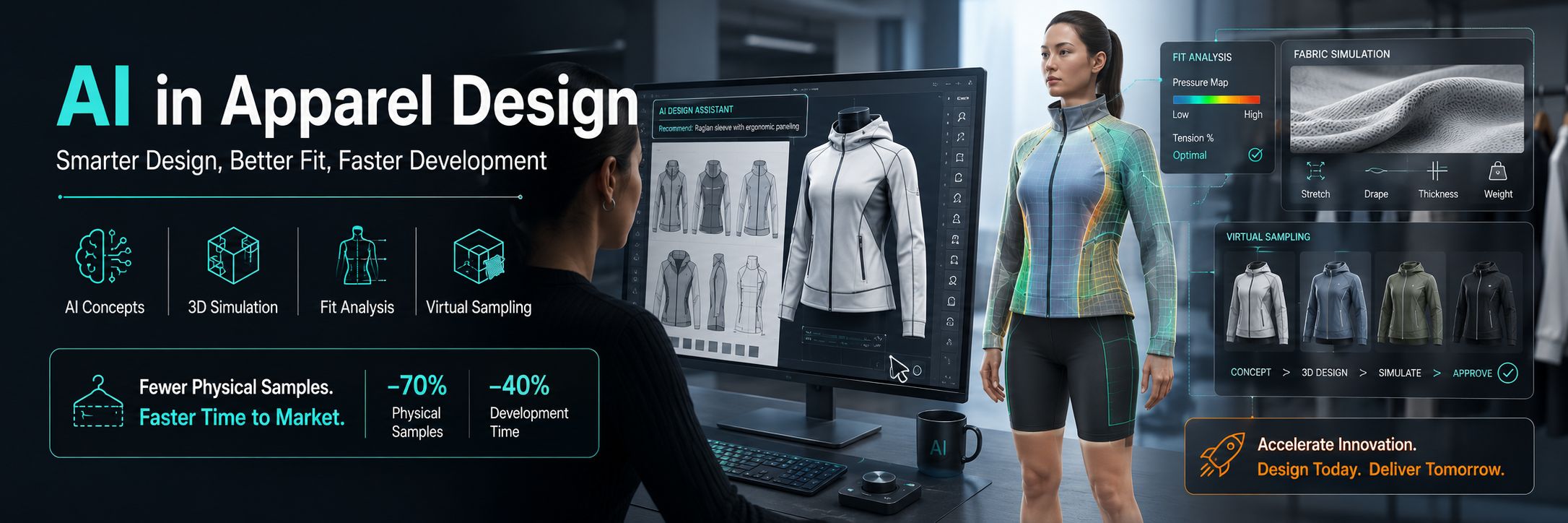
Integrating Creative Generation, Pattern Engineering, Material Data and Production Documentation
Artificial intelligence is no longer a peripheral tool used only to create attractive fashion imagery. In apparel product development, AI is becoming part of a data-driven workflow that connects concept generation, trend interpretation, digital prototyping, material evaluation, technical documentation, costing and production preparation. Its real value appears when generative outputs are translated into controlled product data and verified by design, pattern, material and manufacturing specialists.
The critical mistake is to treat AI as a substitute for the designer, pattern engineer, garment technologist or material specialist. AI can accelerate research, organize information, generate design alternatives and support repetitive documentation work, but it cannot independently validate fit, fabric behavior, sewing feasibility, dimensional stability or production risk. Human technical assessment remains essential at every stage where a digital concept becomes a physical garment.
In professional apparel development, a style is not complete when the visual silhouette looks convincing. It must be converted into a pattern, graded size range, fabric specification, marker layout, sewing method, bill of materials, technical pack, cost calculation and quality-control criteria. For this reason, AI should be understood not as an isolated image-generation tool, but as a controlled layer within the full product-development chain.
In professional apparel development, a style is not complete when the visual silhouette looks convincing. It must be converted into a pattern, graded size range, fabric specification, marker layout, sewing method, bill of materials, technical pack, cost calculation and quality-control criteria. For this reason, AI should be understood not as an isolated image-generation tool, but as a controlled layer within the full product-development chain.
1. AI as a Tool for Trend Analysis and Collection Direction
The first area of AI application concerns the analysis of market information. Traditionally, designers relied on fashion shows, trend reports, street observation, social media, sales data and intuition. Today, AI can process large volumes of visual and textual data, identifying recurring directions in color, silhouette, detail, length, proportion, texture, print and consumer preference.
In practice, this may include the analysis of:
In practice, this may include the analysis of:
- competitor product images,
- collections from e-commerce platforms,
- customer behavior in online stores,
- returns and complaints,
- popularity of particular silhouettes,
- seasonality of colors,
- user reactions in social media,
- local differences in aesthetic preferences.
2. Generating Design Concepts
The most visible application of AI in fashion is image generation. Generative tools can create moodboards, silhouettes, styling sets, color variants, prints, textures and campaign visuals. For the designer, this significantly accelerates the exploration stage.
AI can generate dozens of variants of an outdoor jacket, cocktail dress, streetwear hoodie or workwear trousers from a short description. It can change length, proportion, color, stitch character, pocket layout, collar type, fastening method or the placement of decorative elements.
However, an image generated by AI is not yet an apparel design in the technical sense. It is a visual proposal. It may inspire, but it does not automatically contain information about pattern construction, garment sections, seam allowances, assembly technology, material behavior, consumption, sizing or production cost.
For this reason, a professional designer should treat AI as a tool for quickly creating directions, not as the final source of technical documentation. Every generated silhouette must be translated into real technical decisions.
AI can generate dozens of variants of an outdoor jacket, cocktail dress, streetwear hoodie or workwear trousers from a short description. It can change length, proportion, color, stitch character, pocket layout, collar type, fastening method or the placement of decorative elements.
However, an image generated by AI is not yet an apparel design in the technical sense. It is a visual proposal. It may inspire, but it does not automatically contain information about pattern construction, garment sections, seam allowances, assembly technology, material behavior, consumption, sizing or production cost.
For this reason, a professional designer should treat AI as a tool for quickly creating directions, not as the final source of technical documentation. Every generated silhouette must be translated into real technical decisions.
3. AI in Material, Print and Texture Design
One of the most important development directions is the connection between AI and 3D design. Apparel 3D systems already make it possible to create digital prototypes, simulate material drape, check proportions, fit, tension and garment appearance on an avatar. AI extends this process by enabling faster generation of variants, automatic texture application, styling assistance, visualization generation and sketch interpretation.
In practice, AI-supported 3D design may include:
The greatest value comes from combining three elements: correct 2D pattern construction, reliable material parameters and 3D simulation. If the material in the system is not described with correct weight, stretch, stiffness, thickness and drape parameters, the simulation may look attractive but will not be technologically reliable.
In practice, AI-supported 3D design may include:
- converting a sketch into a garment visualization,
- generating style variants,
- applying prints to a garment form,
- presenting garments on different body shapes,
- creating virtual photo shoots,
- analyzing fit,
- preliminarily checking proportions,
- reducing the number of physical prototypes.
The greatest value comes from combining three elements: correct 2D pattern construction, reliable material parameters and 3D simulation. If the material in the system is not described with correct weight, stretch, stiffness, thickness and drape parameters, the simulation may look attractive but will not be technologically reliable.
4. AI in 3D Design and Virtual Prototyping
One of the most important development directions is the connection between AI and 3D design. Apparel 3D systems already make it possible to create digital prototypes, simulate material drape, check proportions, fit, tension and garment appearance on an avatar. AI extends this process by enabling faster generation of variants, automatic texture application, styling assistance, visualization generation and sketch interpretation.
In practice, AI-supported 3D design may include:
The greatest value comes from combining three elements: correct 2D pattern construction, reliable material parameters and 3D simulation. If the material in the system is not described with correct weight, stretch, stiffness, thickness and drape parameters, the simulation may look attractive but will not be technologically reliable.
In practice, AI-supported 3D design may include:
- converting a sketch into a garment visualization,
- generating style variants,
- applying prints to a garment form,
- presenting garments on different body shapes,
- creating virtual photo shoots,
- analyzing fit,
- preliminarily checking proportions,
- reducing the number of physical prototypes.
The greatest value comes from combining three elements: correct 2D pattern construction, reliable material parameters and 3D simulation. If the material in the system is not described with correct weight, stretch, stiffness, thickness and drape parameters, the simulation may look attractive but will not be technologically reliable.
5. AI in Pattern Engineering and Fit
AI can support the pattern engineering process, but it should not be treated as an automatic pattern maker. Apparel pattern construction requires knowledge of anthropometry, wearing ease, construction allowances, material properties, sewing technology, garment behavior after washing and the requirements of a specific user group.
AI can help with:
This does not mean that the pattern maker becomes unnecessary. On the contrary, the role becomes more analytical. The pattern maker must be able to assess whether an AI suggestion is consistent with pattern engineering principles, material properties and production technology.
AI can help with:
- analyzing size charts,
- detecting inconsistencies between sizes,
- predicting fit problems,
- comparing body measurements and garment measurements,
- automating basic pattern blocks,
- suggesting proportion corrections,
- analyzing returns related to sizing,
- personalizing the size for the customer.
This does not mean that the pattern maker becomes unnecessary. On the contrary, the role becomes more analytical. The pattern maker must be able to assess whether an AI suggestion is consistent with pattern engineering principles, material properties and production technology.
6. AI and Material Selection
Material selection is one of the most critical stages in apparel design. The same style made from different materials can behave completely differently. A rigid woven fabric, elastic knit, elastane fabric, laminate, softshell, synthetic leather or lightweight viscose requires different construction and technological assumptions.
AI can support material selection by analyzing:
AI can also help search for material substitutes. If the original fabric is unavailable, the system can suggest an alternative with similar weight, composition, stretch, width and user-performance characteristics. The final decision still requires laboratory testing and a trial sample, but the selection stage can be much faster.
AI can support material selection by analyzing:
- fiber composition,
- fabric weight,
- stretch,
- elastic recovery,
- thickness,
- stiffness,
- drape,
- shrinkage,
- tendency to deformation,
- compatibility with printing, fusing and sewing.
AI can also help search for material substitutes. If the original fabric is unavailable, the system can suggest an alternative with similar weight, composition, stretch, width and user-performance characteristics. The final decision still requires laboratory testing and a trial sample, but the selection stage can be much faster.
7. AI in Technical Documentation
One of the most practical applications of AI is support in preparing product documentation. In many companies, documentation is created manually across different spreadsheets, PDF files, email descriptions and PLM systems. This leads to errors, duplicated data and inconsistencies between design, pattern making, purchasing and production.
AI can support the preparation of:
A professional AI implementation should therefore begin not with image generation, but with the organization of product data. Without this, it is difficult to speak about real automation in collection development.
AI can support the preparation of:
- style descriptions,
- technical specification sheets,
- sewing instructions,
- component lists,
- bills of materials,
- material descriptions,
- color variants,
- prototype comments,
- change summaries,
- supplier documentation,
- e-commerce product descriptions.
A professional AI implementation should therefore begin not with image generation, but with the organization of product data. Without this, it is difficult to speak about real automation in collection development.
8. AI in Costing and Product Optimization
An apparel design must be not only attractive, but also feasible from a cost perspective. AI can support the analysis of material costs, labor intensity, trim consumption, technological variants and the impact of design decisions on the final price.
For example, the system can compare several variants:
This allows the designer to make decisions faster: whether to simplify a detail, change the material, reduce the number of stitch lines, use a different type of trim or prepare two product versions - premium and commercial.
For example, the system can compare several variants:
- a jacket with lining and without lining,
- trousers with one or two pocket types,
- a hoodie with embroidery, print or applique,
- a dress with a concealed zipper or button fastening,
- a product made from local or imported fabric,
- a style with simpler or more complex sewing technology.
This allows the designer to make decisions faster: whether to simplify a detail, change the material, reduce the number of stitch lines, use a different type of trim or prepare two product versions - premium and commercial.
9. AI, Personalization and Customer-Oriented Design
AI has a strong impact on the development of personalization. In e-commerce, it can support size selection, silhouette recommendation, styling suggestions, product presentation on different body shapes and the creation of individual color variants.
In apparel production, personalization may mean:
The future of personalization in apparel is therefore not unlimited freedom. It is more likely to be based on intelligently controlled variants that give the customer a sense of individuality while allowing the company to maintain process stability.
In apparel production, personalization may mean:
- individual size selection,
- length modification,
- color selection,
- print modification,
- personalized embroidery,
- adjusting the silhouette to body type,
- made-to-order production.
The future of personalization in apparel is therefore not unlimited freedom. It is more likely to be based on intelligently controlled variants that give the customer a sense of individuality while allowing the company to maintain process stability.
10. Limitations of AI in Apparel Design
AI has strong potential, but its limitations are particularly visible in the apparel industry because clothing is a physical product. An image may look impressive, but the garment must be sewn, fitted, washed, pressed, packed and used.
Most common limitations of AI include:
Most common limitations of AI include:
- lack of real understanding of garment construction,
- incorrect element proportions,
- unrealistic details,
- incorrect fastenings,
- lack of logical pattern segmentation,
- ignoring material directionality,
- insufficient understanding of woven and knitted fabric behavior,
- generating elements that are difficult or impossible to manufacture,
- lack of cost control,
- risk of similarity to existing designs,
- copyright issues,
- lack of result repeatability.
11. Copyright, Ethics and Responsibility
The use of AI in apparel design requires particular care in the area of copyright and intellectual property. Generative models are trained on large datasets, and their output may sometimes resemble existing designs, styles, graphics or campaigns.
A company should define:
A company should define:
- which AI tools are approved for work,
- whether generated images can be used commercially,
- who is responsible for checking similarity to third-party designs,
- how prompts and outputs should be archived,
- how AI-generated content should be labeled,
- whether company data may be entered into external tools,
- how sketches, collections and technical documentation should be protected.
12. How to Implement AI in an Apparel Company
AI implementation should be a process, not a one-time experiment. It is best to start with areas that bring a quick effect but do not threaten production quality.
A recommended implementation sequence is:
A recommended implementation sequence is:
- trend and inspiration analysis,
- moodboard generation,
- creation of color variants,
- print design,
- marketing visualizations,
- product descriptions,
- technical documentation support,
- integration with 3D design,
- fit and return analysis,
- costing support,
- data automation in PLM, PDM or ERP.
13. The New Role of the Designer
AI changes the role of the apparel designer. The designer of the future will not only be a person who sketches a style. They will be a curator of aesthetic direction, an operator of digital tools, a data analyst, a partner to pattern engineering and technology, and the person responsible for product coherence.
Key designer competencies will include:
Key designer competencies will include:
- the ability to formulate precise prompts,
- knowledge of materials,
- understanding of pattern construction,
- basic 3D design competence,
- control of production feasibility,
- cost awareness,
- copyright awareness,
- working with product data,
- cooperation with PLM and CAD/CAM environments.
Conclusion
AI in apparel design is not a temporary trend, but the beginning of a deeper change in the way collections are created. Its greatest value lies in accelerating conceptual work, analyzing data, generating variants, supporting 3D design, enabling personalization and organizing product documentation.
However, an AI-generated image should not be confused with a finished technical design. Apparel still requires pattern construction, material selection, technology, testing, costing, documentation and quality control. AI can significantly improve these processes, but only when it is combined with the knowledge of the designer, pattern maker, technologist, material specialist and production team.
The future of apparel design will not be based on replacing people with algorithms. It will be based on cooperation between people and systems that can analyze, generate, compare and organize data faster. The greatest advantage will be gained by companies that do not treat AI as a toy for creating images, but as an element of a professional, controlled and technically structured product development process.
However, an AI-generated image should not be confused with a finished technical design. Apparel still requires pattern construction, material selection, technology, testing, costing, documentation and quality control. AI can significantly improve these processes, but only when it is combined with the knowledge of the designer, pattern maker, technologist, material specialist and production team.
The future of apparel design will not be based on replacing people with algorithms. It will be based on cooperation between people and systems that can analyze, generate, compare and organize data faster. The greatest advantage will be gained by companies that do not treat AI as a toy for creating images, but as an element of a professional, controlled and technically structured product development process.